Solar Roof Tiles: A Comprehensive Guide to Integrated Solar Roofing Solutions
Introduction
In an era where sustainable energy is no longer a luxury but a necessity, Solar Roof Tiles—also known as solar shingles or building-integrated photovoltaics (BIPV)—represent a revolutionary fusion of architecture and renewable power generation. Unlike traditional solar panels that sit atop existing roofs, solar roof tiles replace conventional roofing materials entirely, seamlessly blending energy production with aesthetic appeal. As of December 2025, these innovative products have gained significant traction, driven by advancements in photovoltaic technology, declining costs, and heightened environmental awareness. This detailed article explores the intricacies of solar roof tiles, from their mechanics and benefits to leading products, installation considerations, and future prospects.
What Are Solar Roof Tiles?
Solar roof tiles are compact photovoltaic modules engineered to mimic the appearance and functionality of standard roofing materials, such as asphalt shingles, slate, clay tiles, or metal roofing. At their core, they consist of tempered glass or durable composites encasing silicon-based solar cells, which convert sunlight into direct current (DC) electricity. This electricity is then inverted to alternating current (AC) for home use, much like traditional panels.
The key innovation lies in their dual role: they generate clean energy while providing structural protection against weather elements like rain, wind, hail, and snow. Early iterations, commercially available since around 2005, were bulky and inefficient, but modern designs achieve efficiencies comparable to rack-mounted panels (typically 15-22%). For instance, tiles use PERC (Passivated Emitter and Rear Cell) monocrystalline cells for optimal performance, operating effectively in temperatures from -40°C to 90°C and offering waterproofing to prevent leaks.
Unlike add-on solar systems, solar tiles are installed as the primary roofing layer, eliminating the need for separate shingles or underlayment in many cases. This integration preserves rooflines and enhances curb appeal, making them ideal for historic districts, modern homes, or any structure where visual harmony is paramount.
How Do Solar Roof Tiles Work?
The technology behind solar roof tiles is rooted in photovoltaic principles but tailored for integration. Here’s a step-by-step breakdown:
- Sunlight Absorption: Photovoltaic cells within each tile capture photons from sunlight, exciting electrons to create an electric current.
- Energy Conversion: The DC electricity generated is wired through the roof’s framework to a central inverter, which converts it to usable AC power for appliances, lighting, or grid export.
- Structural Integration: Tiles interlock like puzzle pieces, often with built-in flashing and seals for weatherproofing. Non-solar “inactive” tiles are used in shaded or low-output areas to maintain uniformity.
- Energy Management: Paired with batteries like Tesla’s Powerwall, excess energy is stored for nighttime or outage use, enabling energy independence.
Efficiency varies by design—flat tiles on sloped roofs (minimum 18° pitch) may produce slightly less than optimally tilted panels due to fixed angles, but advancements like color filters and anti-reflective coatings mitigate this. Output is measured in watts per square foot; a typical 1,500 sq ft roof might generate 5-10 kW, offsetting 70-100% of average household usage depending on location and sunlight exposure.
Benefits of Solar Roof Tiles
Solar roof tiles offer multifaceted advantages over traditional panels, appealing to eco-conscious homeowners and builders alike.
Aesthetic and Architectural Harmony
One of the most compelling benefits is their discreet appearance. Traditional panels can dominate a roof’s silhouette, but tiles blend seamlessly, mimicking slate, concrete, or dragon-scale patterns inspired by Swiss alpine roofs. This preserves property aesthetics, boosting curb appeal and resale value—studies show homes with integrated solar can command 4-6% higher prices.
Durability and Longevity
Engineered for extreme conditions, solar tiles boast hail ratings up to Class 5+ (withstanding 140 mph winds) and warranties spanning 25-50 years. They resist corrosion, UV degradation, and thermal expansion better than many standard roofs, potentially outlasting them by decades.
Cost Savings and Incentives
While upfront costs are higher (detailed below), tiles provide dual value: a new roof plus solar generation. Over 25 years, they can slash utility bills by 50-100%, with payback periods of 7-12 years. U.S. federal tax credits (30% via the Inflation Reduction Act) and state rebates further reduce net expenses. In California, additional perks like net metering amplify returns.
Environmental Impact
By generating on-site power, tiles reduce reliance on fossil fuels, cutting CO2 emissions by up to 100 tons over their lifespan. Their BIPV design minimizes material use, promoting sustainable construction.
Additional Perks
- Space Efficiency: No roof penetrations mean fewer leak risks.
- Scalability: Modular designs suit various roof sizes and styles.
- Quiet Operation: No mechanical parts, unlike some hybrid systems.
Drawbacks and Challenges
Despite their allure, solar roof tiles aren’t for everyone.
Higher Initial Costs
Expect $20-50 per square foot installed, versus $3-5 for panels plus $5-15 for a standard roof. A 2,000 sq ft system might total $40,000-$100,000 before incentives, compared to $20,000-$30,000 for panels on an existing roof.
Installation Complexity
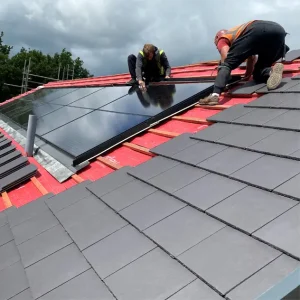
Full roof replacement is required, extending timelines to 1-7 days. Certified installers are essential, and compatibility is limited to certain pitches and orientations.
Performance Trade-offs
Fixed angles can reduce output by 10-20% in suboptimal climates. Shaded areas require non-solar tiles, diluting efficiency.
Limited Availability
Supply chain issues, like rare earth material shortages, have historically delayed projects (e.g., Tesla’s 2023 pauses). As of late 2025, adoption remains niche, with panels dominating 95% of installations.
User forums, such as Reddit discussions, highlight these pain points: one homeowner noted tiles cost “a third more” than panels plus shingles, while another praised GAF’s competitive pricing for 100% offset.
Installation Process
Installing solar roof tiles demands precision:
- Assessment: A site survey evaluates roof condition, pitch, shading, and energy needs.
- Design: Using tools like Revit or ArchiCAD, layouts optimize active tiles.
- Removal and Prep: Old roofing is stripped; structural reinforcements added if needed.
- Laying Tiles: Starting from the eaves, tiles are interlocked and wired in series/parallel configurations.
- Integration: Inverter, battery, and monitoring systems are connected.
- Permitting and Activation: Inspections ensure code compliance; grid interconnection follows.
Professional installation is non-negotiable—DIY voids warranties. Costs include labor ($10-20/sq ft) and potential structural upgrades.
Cost Analysis and Return on Investment
As of 2025, a 10 kW system (covering ~1,000 sq ft) averages $50,000-$80,000 installed, dropping to $35,000-$56,000 post-30% federal credit. Annual savings: $1,000-$2,000 in electricity, plus avoided roof replacement (~$10,000 every 20 years).
ROI hinges on sunlight (e.g., 5-6 peak sun hours/day in sunny regions) and incentives. Tools like PVWatts calculator estimate outputs; payback often occurs in 8-10 years, with 20+ years of free energy thereafter.
Future Trends
The solar tile market is poised for explosive growth, projected to reach $20 billion globally by 2030. Innovations include perovskite cells for 25%+ efficiencies, flexible tiles for curved roofs, and AI-optimized layouts. Regulatory pushes, like EU mandates for solar-ready buildings, will accelerate adoption. Challenges like recycling end-of-life tiles are being addressed through circular economy initiatives.
Conclusion
Solar roof tiles embody the pinnacle of sustainable design: elegant, efficient, and enduring. For homeowners eyeing a new roof or solar upgrade, they offer unparalleled integration, transforming homes into self-sufficient powerhouses without sacrificing style. While costs and complexities persist, evolving technology and incentives make them increasingly viable. Consult certified installers and leverage tools like DSIRE for localized rebates to determine if solar tiles illuminate your path to energy independence. As we hurtle toward a greener future, these unassuming tiles may just redefine rooftops worldwide.
More articles by InnovateIQ Researche:
https://www.zionmarketresearch.com/de/report/smart-pet-feeder-market
https://www.zionmarketresearch.com/de/report/over-the-counter-otc-hearing-aids-market
https://www.zionmarketresearch.com/de/report/point-of-sale-display-market
https://www.zionmarketresearch.com/de/report/neopentyl-glycol-npg-market
https://www.zionmarketresearch.com/de/report/food-minerals-market