Process Gas Compressors Are Specialized Machines designed to compress gases used in industrial processes, increasing pressure for efficient transportation, processing, or reaction. Unlike general air compressors, they handle diverse gases like natural gas, hydrogen, CO₂, syngas, ethylene, or corrosive mixtures, often under high pressures (up to 600 bar or more) and demanding conditions.
These compressors are essential in oil & gas, petrochemicals, refining, chemical manufacturing, power generation, and emerging sectors like hydrogen production and CCUS. The global process gas compressor market is growing steadily, valued at around USD 5–11 billion in recent years, with projections to USD 7–15 billion by 2032 at CAGRs of 3–4%, driven by energy demand, industrial expansion, and decarbonization efforts.
History and Development
Gas compression traces back to the 17th century with early air pumps, but industrial process gas compressors emerged in the late 19th–early 20th century alongside chemical and gas industries. Multistage compressors developed for liquefying technical gases and higher pressures in chemical processes.
Post-WWII advancements in gas turbines and turbo machinery accelerated centrifugal and axial designs. Reciprocating compressors evolved with non-lubricated versions in the 1930s for purity needs. The oil & gas boom in the mid-20th century standardized designs under API 618 for reciprocating and API 617 for centrifugal. Recent decades focus on efficiency, emissions reduction, and handling new gases like hydrogen, with digital monitoring and variable speed drives.
How Process Gas Compressors Work
Compression reduces gas volume, increasing pressure per Boyle’s law. Types use positive displacement (trapping and squeezing gas) or dynamic (imparting velocity then converting to pressure).
Key considerations: Gas properties (MW, corrosiveness), pressure ratios, flow rates, purity (oil-free vs. injected), and interstage cooling for efficiency.
Types of Process Gas Compressors
- Reciprocating — Piston-cylinder design; high pressure ratios, flexible for varying gases. Dominant in high-pressure (33% market) and sour gas applications. Often API 618 compliant.
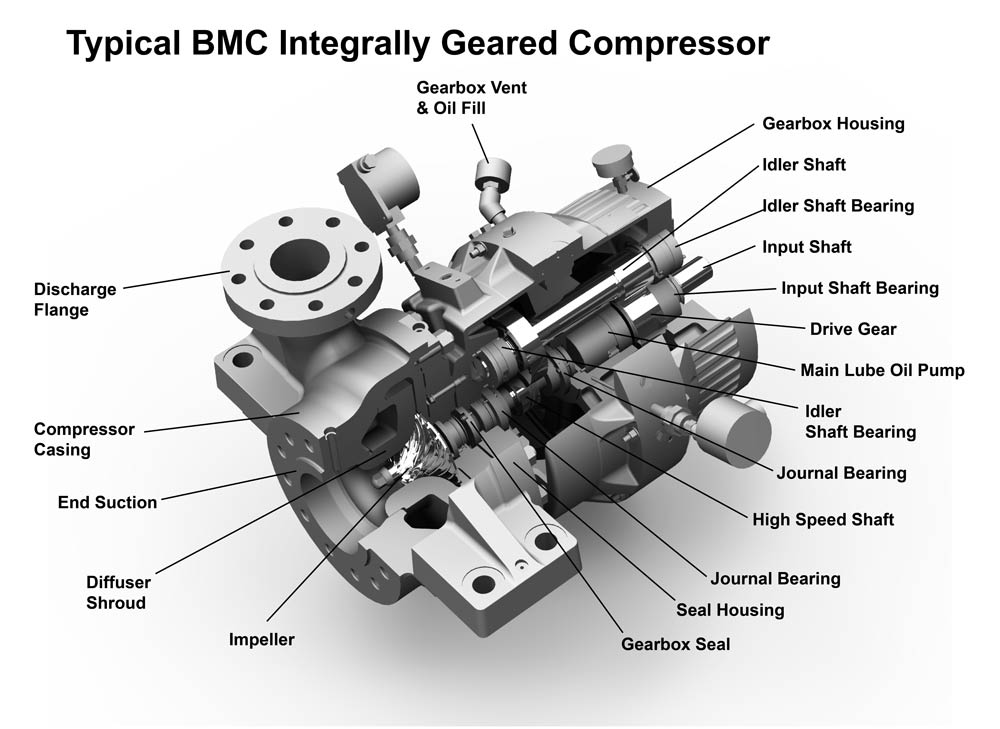
- Centrifugal — Impeller accelerates gas, diffuser converts velocity to pressure; high flow, continuous duty. Largest share (~36%), ideal for large-scale processing.
- Screw — Rotary positive displacement; oil-injected or oil-free. Good for medium pressures, dirty gases (~22% market).
Others: Diaphragm (ultra-pure/high-pressure), axial (very high flow).
Applications
- Oil & Gas → Pipeline transport, gas gathering, reinjection, LNG.
- Petrochemical/Chemical → Feedstock compression, refrigeration, syngas.
- Power Generation → Fuel gas boosting.
- Industrial Gases → Air separation, hydrogen.
- Emerging → CCUS, green hydrogen.
Advantages and Challenges
Advantages:
- Enable efficient gas handling.
- Customizable for corrosive/toxic gases.
- High reliability with proper maintenance.
Challenges:
- High capital/maintenance costs.
- Emissions/vibrations (reciprocating).
- Material compatibility for H₂/CO₂.
- Energy intensity.
Key Players and Market Trends
Major manufacturers: Atlas Copco, Siemens Energy, Ingersoll Rand, MAN Energy Solutions, Ariel Corporation, Burckhardt Compression, Howden, Sundyne.
Trends: Energy-efficient designs (48% new systems target >10% gains), digitalization, hydrogen-ready compressors, Asia-Pacific growth.
In conclusion, process gas compressors are vital for modern industrial processes, evolving with energy transitions. Selection depends on gas type, pressure/flow, and purity needs—consult standards like API 618/617 and specialists for optimal solutions.
More articles by ZMR Researche:
https://www.zionmarketresearch.com/de/report/thermoplastic-pipe-market
https://www.zionmarketresearch.com/de/report/colored-pencils-market
https://www.zionmarketresearch.com/de/report/one-way-degassing-valve-market
https://www.zionmarketresearch.com/de/report/ashbin-market
https://www.zionmarketresearch.com/de/report/wheelchair-accessible-vehicle-converters-market