Hydrocarbon analyzers are sophisticated instruments designed to detect, measure, and analyze hydrocarbons in gases, liquids, or air. These devices are essential across industries such as oil and gas, environmental monitoring, petrochemical processing, emissions control, and air quality assessment. Hydrocarbons, organic compounds primarily composed of hydrogen and carbon (e.g., methane, ethane, propane, and volatile organic compounds or VOCs), can pose safety risks, environmental hazards, or indicate process inefficiencies when present in excessive amounts.
The primary goal of hydrocarbon analyzers is to quantify Total Hydrocarbons (THC), Non-Methane Hydrocarbons (NMHC), or specific individual compounds. Applications range from ensuring purity in industrial gases (e.g., in air separation units) to monitoring emissions compliance and detecting leaks in pipelines. With growing emphasis on environmental regulations and process safety, the market for these analyzers is expanding, driven by advancements in sensor technology and real-time monitoring capabilities.
How Hydrocarbon Analyzers Work
Most hydrocarbon analyzers operate on principles that ionize or absorb energy from hydrocarbon molecules to generate measurable signals.
The most common technology is the Flame Ionization Detector (FID), where sample gas mixes with hydrogen fuel and burns in a flame. Hydrocarbons ionize, producing a current proportional to their concentration. FIDs excel at measuring THC continuously with high sensitivity (down to ppb levels).
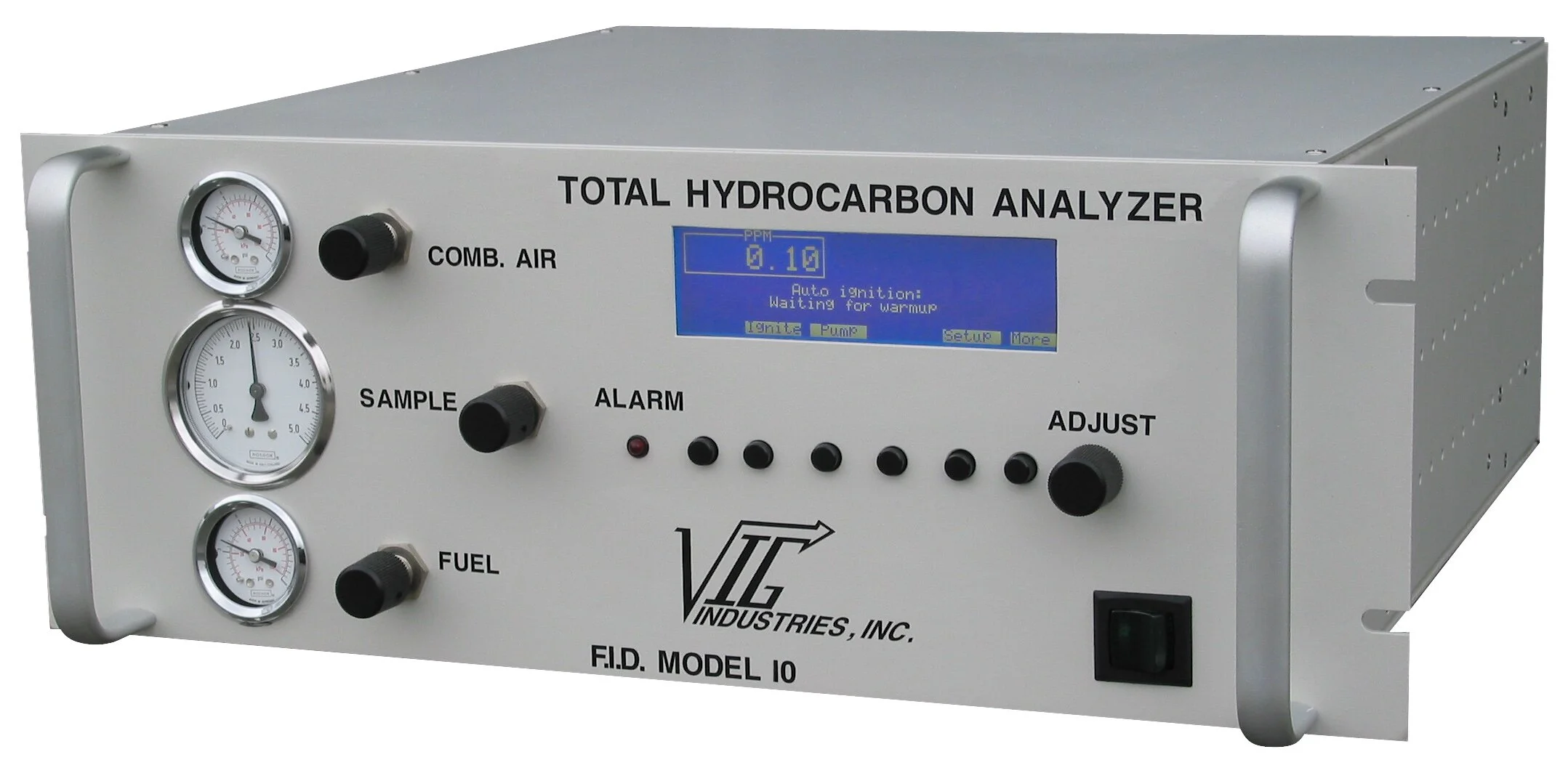
A typical FID-based analyzer in an industrial setup:
Another FID instrument for total hydrocarbon monitoring:
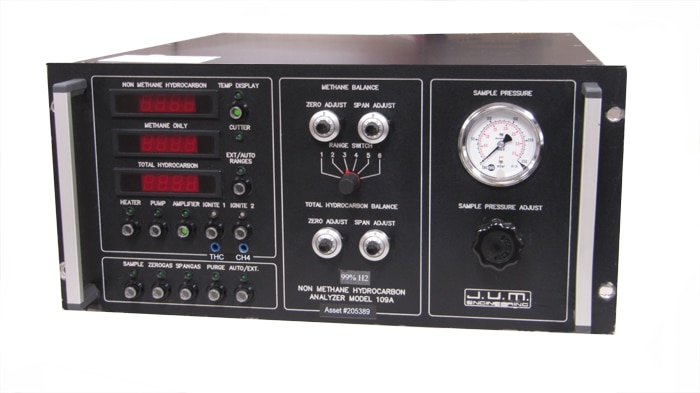
Modern FID analyzer with dual-channel capability for THC and methane:
Some systems use Non-Dispersive Infrared (NDIR) absorption, where hydrocarbons absorb specific infrared wavelengths, reducing light intensity detected by a sensor. This suits certain applications like oil-in-water monitoring.
Infrared-based hydrocarbon analyzer:
Types of Hydrocarbon Analyzers
Hydrocarbon analyzers vary by detection method, portability, and specificity.
Flame Ionization Detector (FID) Analyzers
These provide continuous THC measurement and often include NMHC cutters for separating methane. They suit emissions monitoring, process control, and safety in oxygen-rich environments.
Heated FID for high-temperature applications:
Gas Chromatography (GC)-Based Analyzers
GC separates individual hydrocarbons before detection (often via FID), enabling detailed composition analysis (Detailed Hydrocarbon Analysis or DHA).
Gas chromatograph system for hydrocarbon separation:
Advanced GC setup for petrochemical analysis:
GC instrument for detailed hydrocarbon profiling:
Other Types
- Infrared (IR) Analyzers — For total hydrocarbons in specific ranges.
- Photoionization Detectors (PID) — For VOCs in portable units.
- Chilled Mirror Analyzers — For hydrocarbon dew point in natural gas pipelines.
- Portable Analyzers — Handheld devices for field leak detection or spot checks.
Portable hydrocarbon analyzer for on-site use:
Another portable model:
Key Players and Products
Leading manufacturers include:
- Servomex → SERVOPRO FID series for trace THC.
- HORIBA → APHA-370 and FID-based systems.
- AMETEK MOCON → Baseline 9000 THC analyzers.
- ABB → Advanced analyzers for process applications.
- Siemens → FIDAMAT series.
- VIG Industries → Custom FID systems.
- Michell Instruments → Condumax II for hydrocarbon dew point.
- ZEGAZ Instruments → CEIRS™ technology for dew point.
Online process THC analyzer in industrial enclosure:
Rack-mounted total hydrocarbon analyzer:
Compact process analyzer unit:
Applications
- Oil & Gas/Petrochemical → Monitoring impurities in natural gas, LNG, refineries; hydrocarbon dew point for pipeline integrity.
- Environmental & Emissions → VOC/THC in stack gases, ambient air, fence-line monitoring.
- Industrial Safety → Detecting flammable hydrocarbons in pure gases (O₂, N₂ plants).
- Water Analysis → Oil/hydrocarbons in wastewater, cooling towers.
- Automotive/Engine Testing → Exhaust hydrocarbon measurement.
Challenges and Considerations
Challenges include sensor maintenance (e.g., FID requires fuel gas), interference from other compounds, high initial costs, and need for calibration. Portable units face battery life and ruggedness issues, while online systems require robust sampling in harsh environments.
Future Prospects
Advancements focus on laser spectroscopy (e.g., tunable diode lasers), integration with IoT for remote monitoring, and multi-component analysis. Stricter emissions regulations and the energy transition (including hydrogen blending in natural gas) will drive demand for more precise, low-maintenance analyzers.
Conclusion
Hydrocarbon analyzers are indispensable tools for safety, compliance, and efficiency in industries handling or impacted by hydrocarbons. From FID’s real-time precision to GC’s detailed profiling, these technologies continue to evolve, supporting cleaner processes and environmental protection in a hydrocarbon-dependent world.
More articles by ZMR Researche:
https://www.zionmarketresearch.com/de/report/multiple-toe-socks-market
https://www.zionmarketresearch.com/de/report/fancy-yarn-market
https://www.zionmarketresearch.com/de/report/colon-cancer-diagnostic-market
https://www.zionmarketresearch.com/de/report/breast-cancer-mammography-screening-market
https://www.zionmarketresearch.com/de/report/adaptive-stroller-market