An Oil Accumulator, more commonly known as a hydraulic accumulator in industrial contexts, is a pressure storage device that stores hydraulic fluid (oil) under pressure using compressed gas, typically nitrogen. It plays a critical role in hydraulic systems by storing energy, absorbing shocks, dampening pulsations, compensating for leakage, and providing auxiliary power during peak demands or emergencies.
The term “oil accumulator” emphasizes the hydraulic oil component, distinguishing it from other uses like suction line accumulators in refrigeration systems (which handle refrigerant and oil mixtures). Hydraulic accumulators are widely used in heavy machinery, mobile equipment, industrial presses, oil and gas operations, and renewable energy systems. They enhance system efficiency, reduce pump size requirements, and improve safety by mitigating pressure spikes.
In refrigeration and air conditioning, a separate device called a suction line accumulator (sometimes referred to in context with oil return) protects compressors from liquid slugging while ensuring proper oil circulation.
This article focuses primarily on hydraulic oil accumulators, with a section on their refrigeration counterpart.
A typical hydraulic accumulator integrated into a system:
Another schematic showing accumulator functions in a hydraulic circuit:
How Oil Accumulators Work in Hydraulic Systems
Hydraulic accumulators store potential energy by compressing inert gas (usually dry nitrogen) as hydraulic oil enters the fluid chamber under system pressure. When demand exceeds pump supply or during power loss, the gas expands, forcing oil back into the circuit.
Key principles:
- Gas is compressible, allowing energy storage.
- Oil is incompressible, transmitting force efficiently.
- Pre-charging with nitrogen (to 50-90% of system pressure, depending on function) is essential.
Functions include:
- Energy storage for peak power.
- Shock absorption (e.g., from sudden valve closures).
- Pulsation dampening (from pumps).
- Leakage compensation and thermal expansion handling.
- Emergency power source.
A cutaway view illustrating basic operation:
Types of Hydraulic Oil Accumulators
There are three main types, differentiated by the gas-oil separation method.
Bladder Type
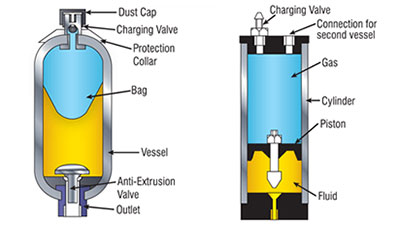
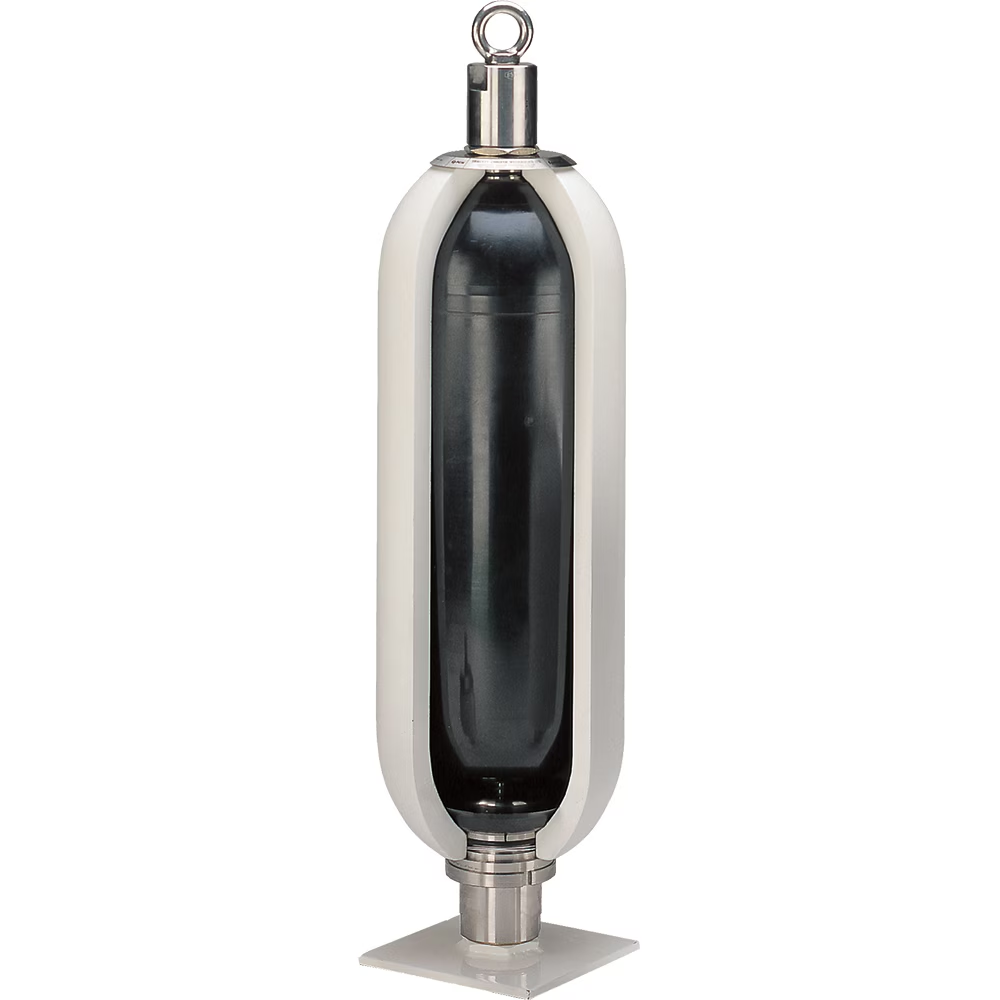
The most common, featuring a flexible rubber bladder filled with gas inside a steel shell. Oil surrounds the bladder.
Advantages: Fast response, good for high-frequency pulsations, repairable. Disadvantages: Limited by bladder life, sensitive to contamination.
Bladder accumulator diagram:
Detailed bladder type cutaway:
Piston Type
Uses a movable piston to separate gas and oil chambers.
Advantages: High pressure ratings, large volumes, long life, suitable for extreme temperatures. Disadvantages: Slower response, potential seal wear.
Piston accumulator cutaway:
Diaphragm Type
Employs a flexible diaphragm (often elastomeric or metal) for separation. Compact and lightweight.
Advantages: Quick response, no moving parts beyond diaphragm, good sealing. Disadvantages: Smaller volume, pressure varies with expansion.
Diaphragm accumulator illustration:
Other less common types include spring-loaded (for low-pressure) and weight-loaded (historical large-scale).
Key Players and Products
Major manufacturers include Parker (Greer), HYDAC, Bosch Rexroth, Freudenberg Sealing Technologies, and Eaton. Products range from small diaphragm units for mobile hydraulics to large piston accumulators for industrial presses.
Installed hydraulic accumulators in machinery:
Applications
- Mobile Equipment: Excavators, cranes—for energy efficiency and shock absorption.
- Industrial: Presses, injection molding—peak power supplementation.
- Oil & Gas: Blowout preventers, pulsation dampening.
- Renewables: Wind turbines for pitch control.
- Automotive: Suspension systems in some vehicles.
Oil Accumulators in Refrigeration Systems
In HVAC/R, the suction line accumulator (often called simply “accumulator”) is installed on the suction line before the compressor. It prevents liquid refrigerant floodback (slugging) that could damage the compressor, while metering back oil and small amounts of liquid for safe return.
Common in heat pumps, low-temperature systems, and those with variable loads.
Refrigeration accumulator diagram:
Maintenance and Safety
Accumulators store high energy and require careful handling:
- Regular pre-charge checks (nitrogen only—never oxygen).
- Bladder/piston inspections.
- Safety blocks for isolation and relief.
- Risks: Sudden discharge if mishandled.
Challenges and Future Trends
Challenges: Gas permeation over time, contamination sensitivity, high initial cost. Trends: Integration with energy-efficient hybrid systems, advanced materials for higher pressures, IoT monitoring.
Conclusion
Oil accumulators are vital for reliable, efficient hydraulic and refrigeration systems, providing energy storage, protection, and smoothness. Proper selection, sizing, and maintenance ensure longevity and safety, making them indispensable in modern engineering applications.
More articles by ZMR Researche:
https://www.zionmarketresearch.com/de/report/disease-management-apps-market
https://www.zionmarketresearch.com/de/report/shapewear-market
https://www.zionmarketresearch.com/de/report/sacral-neuromodulation-market
https://www.zionmarketresearch.com/de/report/polyphenylene-ether-ppe-market
https://www.zionmarketresearch.com/de/report/polytetrafluoroethylene-ptfe-coatings-market