Turbine Motor, commonly referred to as a turbine engine or simply a turbine, is a rotary mechanical device that extracts energy from a fluid flow (typically air, gas, steam, or water) and converts it into useful mechanical work, usually to drive a shaft, generator, or propeller. Turbine motors operate on the principle of fluid dynamics, where high-velocity fluid imparts momentum to blades or vanes mounted on a rotor, causing rotation.
The concept of turbines dates to ancient water wheels, but modern turbine motors emerged in the late 19th century with Charles Parsons’ steam turbine (1884) and subsequent gas turbines by Frank Whittle and Hans von Ohain in the 1930s-1940s. Today, turbine motors power aircraft (jet engines), electricity generation (gas and steam turbines), ships (marine gas turbines), and industrial processes (compressors, pumps). The global gas turbine market alone exceeds USD 20-25 billion annually as of 2025, with steam and hydro turbines adding substantial value. Efficiency improvements, materials advances, and decarbonization efforts (hydrogen-capable turbines) drive ongoing innovation.
Types of Turbine Motors
Turbine Motors are classified by working fluid and design:
- Gas Turbines
- Open cycle (most common): Air compressed, mixed with fuel, combusted, expanded through turbine.
- Subtypes: Aero-derivative (lightweight, aircraft-derived), industrial/heavy-frame (power generation), micro-turbines (10-500 kW distributed power).
- Applications: Aviation (turbojet, turbofan, turboprop), power plants, mechanical drive.
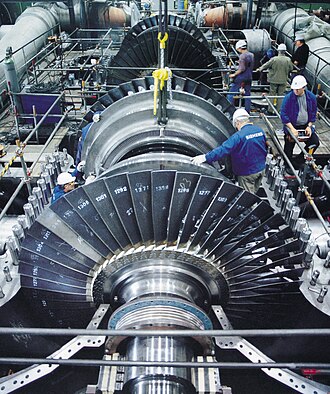
- Steam Turbines
- Steam from boiler expanded through blades.
- Impulse (velocity drop in nozzles) or reaction (pressure drop in blades).
- Applications: Thermal/nuclear power plants, marine propulsion.
- Hydraulic/Water Turbines
- Water flow drives rotor.
- Impulse (Pelton: high head).
- Reaction (Francis, Kaplan: medium/low head).
- Applications: Hydroelectric power.
- Wind Turbines
- Air flow (wind) turns blades connected to generator.
- Horizontal-axis (HAWT) dominant; vertical-axis (VAWT) niche.
- Other Specialized
- Turbochargers (exhaust-driven compressor for IC engines).
- Expander turbines (energy recovery in cryogenics).
Operating Principle
All turbines follow the Euler turbomachinery equation: Torque = mass flow × (tangential velocity change × radius).
Stages:
- Fluid acceleration (nozzles/compressor).
- Energy transfer to rotor (impulse/reaction).
- Exhaust or multi-stage expansion.
Brayton cycle (gas turbines): Compression → combustion → expansion → exhaust. Rankine cycle (steam): Boiler → turbine → condenser → pump.
Efficiency: Gas turbines 35-45% simple cycle, >60% combined cycle (with steam bottoming).
Key Components
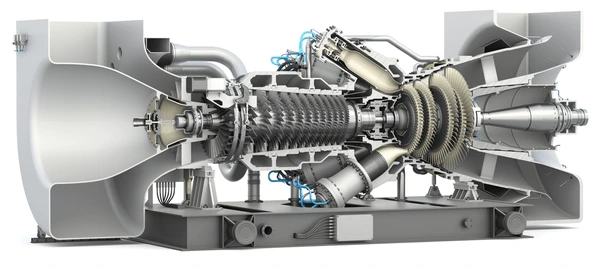
- Compressor: Raises fluid pressure (axial or centrifugal).
- Combustor (gas/steam external): Fuel mixing and burning.
- Turbine Section: Hot gas expansion drives rotor (1-4 stages).
- Rotor/Shaft: Transmits power.
- Bearings and Seals: Support high speeds/temperatures.
- Controls: Fuel flow, variable geometry for efficiency.
Materials: Nickel superalloys, ceramic matrix composites (CMC) for hot sections (>1,500°C tolerance).
Applications
- Aviation Turbofan engines dominate commercial aircraft (CFM LEAP, GE9X).
- Power Generation Combined-cycle gas turbines (CCGT) for flexible grid support; steam in coal/nuclear.
- Marine Gas turbines for fast ships (LM2500 series).
- Industrial Mechanical drive for compressors, pumps (oil & gas).
- Renewables Wind turbines; emerging hydrokinetic.
- Distributed Power Micro-turbines for CHP (combined heat/power).
Advantages
- High power-to-weight ratio (aviation).
- Fast start-up (peaking plants).
- Fuel flexibility (natural gas, hydrogen blends).
- Reliability/long life (20,000-50,000 hours).
Challenges and Limitations
- High initial cost.
- Thermal efficiency limits (Carnot constraint).
- Emissions (NOx, CO₂—mitigated by lean premix, CCS).
- Noise/vibration.
- Material stress at extreme temperatures.
Innovations and Trends
- Hydrogen combustion (100% H₂-capable turbines by Siemens, GE).
- Additive manufacturing for complex cooling passages.
- Digital twins/AI for predictive maintenance.
- Hybrid turbine-battery systems.
- Advanced aerodynamics (higher bypass ratios in aero engines).
Market and Economic Aspects
Growth drivers:
- Energy transition (flexible gas turbines backing renewables).
- Aviation recovery and efficiency demands.
- Distributed generation in remote areas.
Asia-Pacific leads new installations (China, India).
Environmental Impact
Lifecycle emissions vary: Gas turbines ~400-500 g CO₂/kWh simple cycle; lower with CCS or hydrogen. Steam (coal) higher unless CCS. Wind/hydro near-zero operational.
Conclusion
Turbine motors represent a pinnacle of thermodynamic engineering, powering modern transportation, electricity, and industry with remarkable efficiency and adaptability. From Parsons’ steam breakthrough to today’s hydrogen-ready gas turbines, continuous materials and design advances address efficiency, emissions, and flexibility challenges. As decarbonization accelerates, turbine technology evolves to integrate renewables, alternative fuels, and digital intelligence, ensuring its central role in sustainable energy systems worldwide.
More articles by ZMR Researche:
https://www.zionmarketresearch.com/de/report/process-gas-compressor-market
https://www.zionmarketresearch.com/de/report/sintered-zns-lenses-market
https://www.zionmarketresearch.com/de/report/flight-demonstrator-market
https://www.zionmarketresearch.com/de/report/novel-smart-textile-market
https://www.zionmarketresearch.com/de/report/agricultural-shade-nets-market