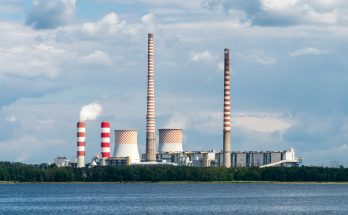
Direct Air Capture (DAC) refers to a set of technologies designed to extract carbon dioxide (CO₂) directly from the ambient air, rather than from concentrated sources like power plant emissions. This process is crucial for addressing climate change because it targets the legacy CO₂ that has accumulated in the atmosphere over decades, contributing to global warming. Unlike traditional carbon capture and storage (CCS) methods, which are typically applied at point sources such as industrial facilities, DAC can be deployed anywhere, making it a versatile tool for carbon removal. As of 2025, DAC is gaining momentum with increasing investments from governments and private sectors, driven by the urgent need to achieve net-zero emissions by mid-century
The concept of DAC isn’t new; it draws from principles used in submarines and spacecraft to scrub CO₂ from enclosed environments. However, scaling it for atmospheric applications presents unique engineering and economic challenges. Proponents argue that DAC could play a pivotal role in limiting global temperature rise to 1.5°C, as outlined in the Paris Agreement, by removing billions of tons of CO₂ annually. Critics, however, point to its high energy demands and costs as barriers to widespread adoption. This article delves into the mechanics, technologies, key developments, challenges, and future potential of DAC systems.
How Direct Air Capture Works
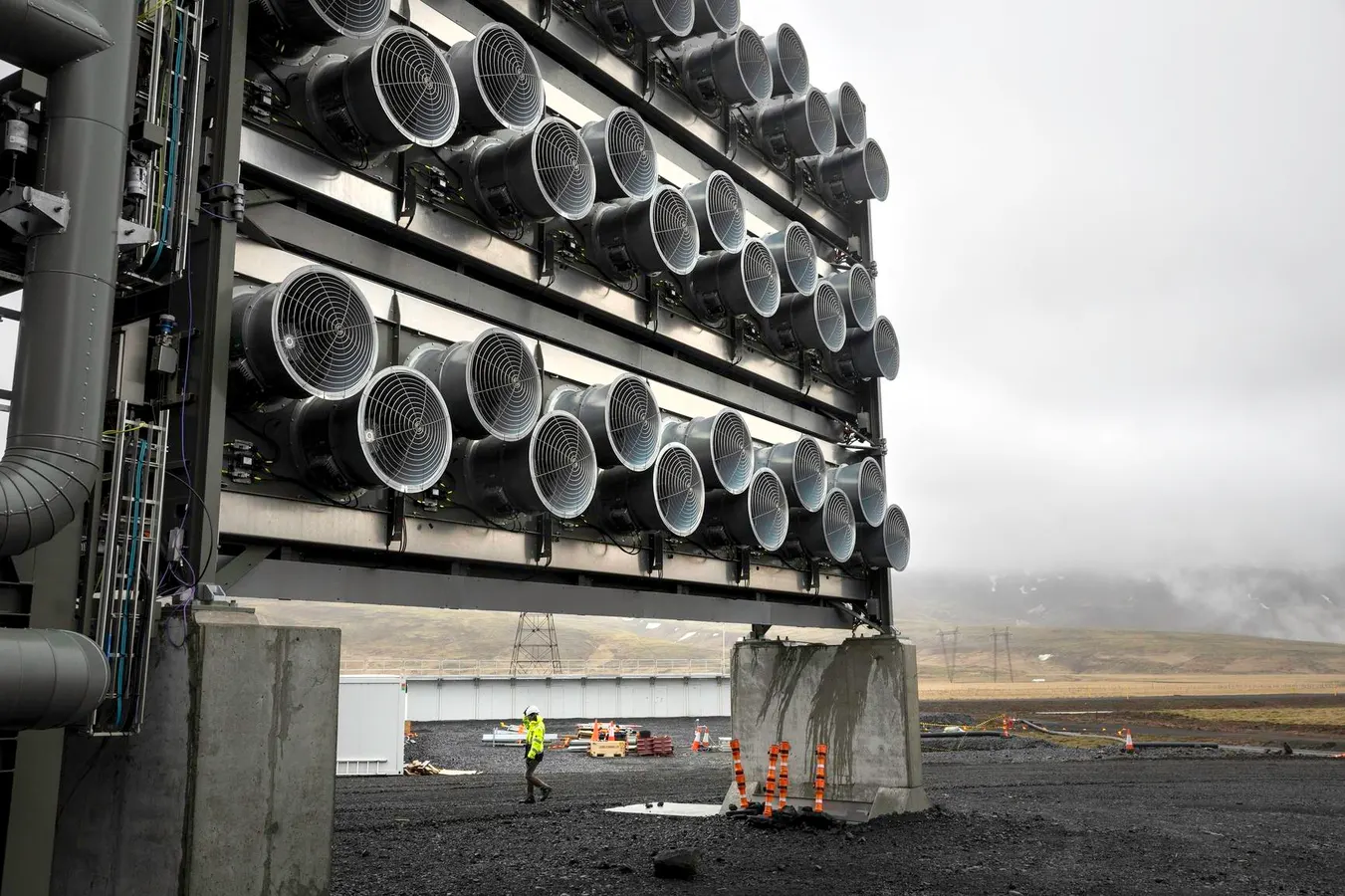
At its core, DAC involves pulling large volumes of air through a system where CO₂ is selectively captured using chemical or physical processes. The process begins with fans or blowers that draw ambient air into contactors—large structures where the air interacts with sorbent materials that bind to CO₂ molecules. Once the sorbent is saturated, it undergoes a regeneration phase where heat, vacuum, or other methods release the captured CO₂ in a concentrated stream. This pure CO₂ can then be compressed, transported, and either stored underground (in geological formations) or utilized in products like synthetic fuels, building materials, or enhanced oil recovery.
The energy required for DAC primarily comes from renewable sources to ensure the process is carbon-negative, meaning it removes more CO₂ than it emits. For instance, the capture phase might use electricity for fans, while regeneration often relies on low-grade heat from geothermal or solar sources. A typical DAC plant processes millions of cubic meters of air daily, but since CO₂ constitutes only about 0.04% of the atmosphere, efficiency is key to making the technology viable.
To visualize the process, consider a simplified diagram of a DAC system, which typically includes air intake, sorbent contact, CO₂ release, and storage stages.
This illustration highlights the modular nature of many DAC designs, allowing for scalability.
Types of DAC Technologies
DAC systems are broadly categorized into two main types based on the sorbent used: liquid-based and solid-based systems.
Liquid-Based Systems
In liquid-based DAC, air is bubbled through or sprayed with an alkaline solution, such as potassium hydroxide (KOH), which reacts with CO₂ to form carbonates. The solution is then heated in a calciner to release the CO₂ and regenerate the sorbent. This method, pioneered by companies like Carbon Engineering (now part of Occidental Petroleum), operates at higher temperatures (around 900°C for regeneration) and is suited for large-scale facilities. Advantages include high capture efficiency and the ability to integrate with existing industrial processes. However, it requires significant water and energy inputs, and the high heat can lead to material degradation over time.
A schematic of a liquid-based DAC process often shows the air contactor as a tall tower where air flows counter-current to the falling liquid sorbent.
This diagram emphasizes the chemical reactions involved, such as the conversion of CO₂ to calcium carbonate before calcination.
Solid-Based Systems
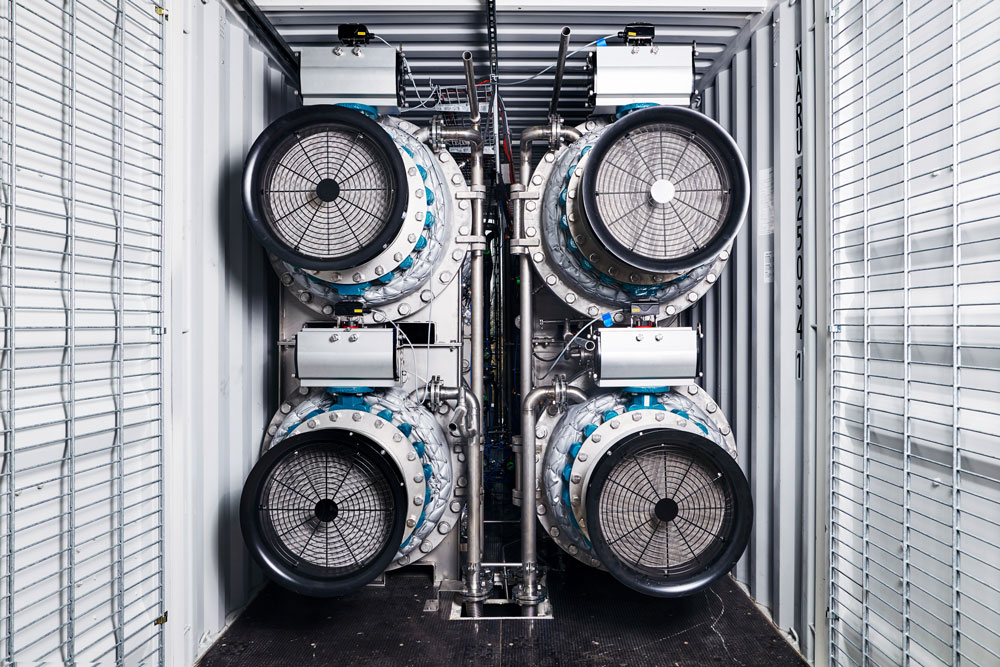
Solid-based DAC uses filters coated with amine-based materials or metal-organic frameworks (MOFs) that adsorb CO₂ at ambient temperatures. Regeneration occurs at lower temperatures (around 80-120°C) using steam or vacuum, making it more energy-efficient in some contexts. Climeworks, a leading Swiss company, employs this technology in modular units that can be stacked like shipping containers. These systems are more compact and flexible, ideal for distributed deployment, but they may have lower capture rates per unit volume compared to liquid systems.
Innovations in solid sorbents, such as moisture-swing adsorption (where CO₂ is released by introducing humidity), are emerging to reduce energy needs further. A typical solid-based setup resembles a large air filter array, as depicted in various engineering blueprints.
This representation captures the flow of air through solid filters and the subsequent regeneration cycle.
Key Players and Developments
The DAC landscape is dominated by a few innovative companies. Climeworks operates the world’s largest DAC plant, Orca in Iceland, which captures 4,000 tons of CO₂ annually and stores it in basalt rock formations. Carbon Engineering’s pilot plant in Squamish, Canada, has demonstrated the feasibility of producing synthetic fuels from captured CO₂. Other notable players include Global Thermostat, which focuses on low-cost modular units, and Heirloom Carbon, which uses enhanced weathering with minerals like limestone.
Government support is accelerating growth. The U.S. Department of Energy’s DAC Hubs program, funded under the Bipartisan Infrastructure Law, aims to deploy gigaton-scale removal by 2050. In Europe, the EU’s Innovation Fund has backed projects like Climeworks’ Mammoth plant, set to capture 36,000 tons per year. Corporate buyers, including Microsoft and Stripe, are purchasing carbon removal credits to offset emissions, creating a voluntary market that could reach $100 billion by 2030.
Challenges and Costs
Despite progress, DAC faces significant hurdles. Current costs range from $250 to $600 per ton of CO₂ removed, far above the $100 threshold needed for economic viability at scale. Energy consumption is another issue; a gigaton-scale DAC deployment could require up to 25% of global electricity if not optimized. Water usage in liquid systems can be substantial, posing risks in arid regions, though some designs recycle water efficiently.
Technical challenges include sorbent durability, as materials degrade over cycles, and the need for secure long-term storage to prevent CO₂ leakage. Additionally, public acceptance and regulatory frameworks for CO₂ transport and injection are still evolving.
Environmental Impact and Benefits
When powered by renewables, DAC can achieve net-negative emissions, helping restore atmospheric CO₂ levels to pre-industrial norms. It complements natural solutions like reforestation, which are limited by land availability. Benefits extend to air quality improvement, as DAC filters can also remove pollutants, and economic opportunities in green jobs.
However, if reliant on fossil fuels, DAC could inadvertently increase emissions. Lifecycle assessments emphasize the importance of low-carbon energy sources.
Future Prospects
Looking ahead, advancements in materials science, such as novel MOFs and electrochemical methods, promise to lower costs to below $100 per ton by 2030. Integration with renewable energy hubs, like solar farms in deserts, could optimize operations. The IPCC projects that DAC might need to remove 5-15 gigatons of CO₂ annually by 2100 to meet climate goals. With policy incentives like tax credits (e.g., the U.S. 45Q credit at $180 per ton for storage), the sector is poised for exponential growth.
Conclusion
Direct Air Capture systems represent a promising frontier in climate mitigation, offering a direct way to reverse humanity’s carbon footprint. While challenges remain, ongoing innovations and supportive policies are paving the way for DAC to become a cornerstone of global sustainability efforts. As technology matures, DAC could transform from a niche solution to a mainstream necessity in the fight against climate change.
More articles by ZMR Researche:
https://www.zionmarketresearch.com/de/report/fintech-market
https://www.zionmarketresearch.com/de/report/testing-inspection-certification-market
https://www.zionmarketresearch.com/de/report/self-improvement-market
https://www.zionmarketresearch.com/de/report/linear-shower-drains-market
https://www.zionmarketresearch.com/de/report/gi-stool-testing-market