Solar photovoltaic (PV) panels, commonly known as solar panels, are devices that convert sunlight directly into electricity through the photovoltaic effect. Composed of interconnected solar cells made primarily from silicon, these panels form the core of solar energy systems, enabling clean, renewable power generation for residential, commercial, industrial, and utility-scale applications.
The photovoltaic effect was discovered in 1839 by Alexandre-Edmond Becquerel, but practical solar cells emerged in 1954 at Bell Laboratories (6% efficiency silicon cell). Commercialization accelerated in the 1970s with space applications and oil crises, with costs plummeting 89% since 2010 due to manufacturing scale and technological advances. As of early 2026, global cumulative PV capacity exceeds 1,600 GW, with 2025 additions surpassing 400 GW—led by China (>50% market). Solar PV now supplies ~8-10% of global electricity, projected to reach 20-30% by 2040 under net-zero scenarios. The levelized cost of electricity (LCOE) from utility-scale PV has fallen below USD 0.03/kWh in sunny regions, making it the cheapest new power source in most countries.
Solar PV panels drive the energy transition, offering modular, silent, zero-emission electricity with minimal maintenance over 25-40 year lifetimes.
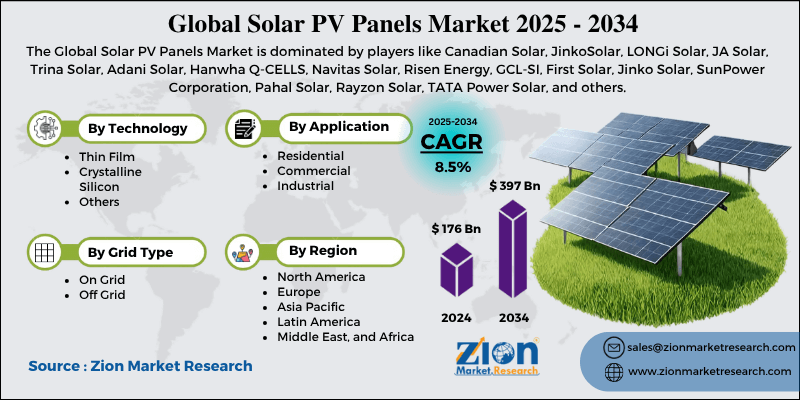
How Solar PV Panels Work
The photovoltaic effect:
- Photons from sunlight strike semiconductor material (silicon).
- Energy excites electrons, creating electron-hole pairs.
- p-n junction separates charges, generating direct current (DC).
- Metal contacts collect current.
Key components per panel:
- Solar Cells: Monocrystalline, polycrystalline, or thin-film.
- Encapsulation: EVA (ethylene vinyl acetate) layers.
- Glass Cover: Tempered, anti-reflective.
- Backsheet: Protects from moisture.
- Frame: Aluminum for rigidity/mounting.
- Junction Box: Diodes, cables.
Efficiency: Commercial panels 18-23%; lab records >25% (monocrystalline), >47% (multi-junction concentrators).
Types of Solar PV Panels
- Monocrystalline Silicon
- Single crystal wafers; uniform black appearance.
- Efficiency: 20-23% commercial.
- Advantages: High efficiency, longevity.
- Cost: Premium.
- Polycrystalline (Multicrystalline) Silicon
- Melted silicon fragments; blue hue.
- Efficiency: 16-20%.
- Advantages: Lower cost.
- Declining share.
- Thin-Film
- Cadmium Telluride (CdTe): First Solar leader; 18-22%.
- CIGS (Copper Indium Gallium Selenide): Flexible.
- Amorphous Silicon: Low-light performance.
- Advantages: Lightweight, flexible, lower material use.
- Disadvantages: Lower efficiency.
- Emerging/Next-Generation
- Perovskite: Rapid gains (>25% lab); tandem with silicon (>33%).
- Bifacial: Capture light both sides (up to 30% gain with reflectors).
- Heterojunction (HJT): Amorphous + crystalline silicon.
- TOPCon: Tunnel oxide passivated contact.
Monocrystalline dominates ~90% market.
Manufacturing Process
- Silicon Production
- Polysilicon from quartz (Siemens process).
- Ingot/Wafer
- Czochralski (mono) or directional solidification (poly).
- Sliced into wafers (~180-200 μm).
- Cell Processing
- Texturing, doping, passivation, anti-reflective coating, screen-printed contacts.
- Module Assembly
- Stringing cells, lamination (EVA/glass/backsheet), framing, junction box.
China >80% production; scale drives cost reductions.
Performance and Efficiency Factors
- Temperature Coefficient: Efficiency drops ~0.3-0.5%/°C above 25°C.
- Irradiance: Proportional output.
- Degradation: 0.5-0.8%/year initial.
- Bifacial Gain: 10-30% extra.
Warranties: 25-30 years (80-90% power).

Applications
- Utility-Scale Solar farms; lowest LCOE.
- Commercial/Industrial Rooftops, carports.
- Residential Rooftop systems; net metering.
- Off-Grid/Remote Pumps, telecom, rural electrification.
- Building-Integrated (BIPV) Facades, windows, tiles.
- Floating Solar Reservoirs; cooling boost.
- Agrivoltaics Dual-use with crops.
Advantages
- Zero operational emissions.
- Modular/scalable.
- Declining costs.
- Long life/low maintenance.
- Energy independence.
Challenges
- Intermittency (storage/grid needed).
- Land use (utility-scale).
- Supply chain (polysilicon, silver).
- Recycling (emerging frameworks).
- Initial cost.
Market Trends (2026)
- Perovskite tandems commercialization.
- Larger wafers (210mm+), higher power (>600W modules).
- Bifacial standard.
- N-type cells (TOPCon, HJT) >90% share.
- Domestic manufacturing (U.S. IRA, EU incentives).
Environmental Impact
Lifecycle emissions: 20-50 g CO₂/kWh (vs. coal 800+). Mining/recycling concerns improving.
Conclusion
Solar PV panels have matured into the fastest-growing, most affordable electricity source, powering the global shift to renewables. Continuous efficiency gains, cost reductions, and integration innovations position PV as central to decarbonization. From residential rooftops to gigawatt farms, panels deliver clean, reliable energy with minimal environmental footprint over decades. As storage and smart grids advance, solar PV will dominate future power systems worldwide.
More articles by ZMR Researche:
https://www.zionmarketresearch.com/de/report/neopentyl-glycol-npg-market
https://www.zionmarketresearch.com/de/report/food-minerals-market
https://www.zionmarketresearch.com/de/report/optical-lens-for-infrared-device-market
https://www.zionmarketresearch.com/de/report/communications-service-providers-csp-market
https://www.zionmarketresearch.com/de/report/animal-radio-collar-market