Ozone Generation refers to the intentional production of ozone (O₃), a highly reactive allotrope of oxygen consisting of three oxygen atoms. Ozone is a powerful oxidant and disinfectant widely used in water treatment, air purification, food processing, medical sterilization, and industrial bleaching. Unlike naturally occurring stratospheric ozone (the “ozone layer” protecting Earth from UV radiation), generated ozone is produced at ground level for specific applications.
Commercial ozone generation began in the late 19th century, with Siemens’ 1857 tube design and industrial-scale use in water treatment by 1906 (Nice, France). Today, ozone is favored for its strong disinfection power without persistent chemical residues—decomposing back to oxygen. The global ozone generation market is valued at approximately USD 1.5-2 billion as of 2025, driven by stringent water quality regulations, demand for chemical-free disinfection, and applications in semiconductor manufacturing and healthcare. Major producers include Xylem (Wedeco), Suez, Mitsubishi Electric, Ozonia (Suez), and Primozone.
Properties of Ozone
Ozone is a pale blue gas with a pungent odor (detectable at 0.01-0.05 ppm):
- Molecular weight: 48 g/mol.
- Boiling point: -112°C.
- Density: 2.14 g/L (heavier than air).
- Solubility: Moderately soluble in water (better at lower temperatures).
- Oxidation potential: 2.07 V (stronger than chlorine 1.36 V).
Ozone decomposes spontaneously (half-life minutes to hours depending on conditions), generating reactive oxygen species (hydroxyl radicals) for disinfection. It is toxic at high concentrations (>0.1 ppm occupational limit), causing respiratory irritation.
Methods of Ozone Generation
Commercial ozone is produced from oxygen-containing gas (air or pure oxygen):
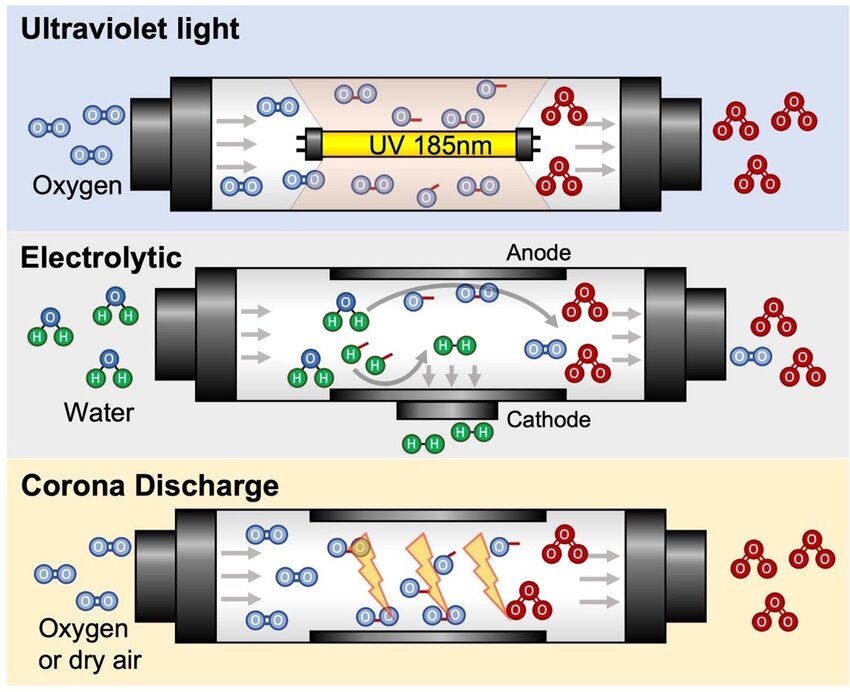
- Corona Discharge (Silent Electric Discharge) Dominant method (>90% production).
- Principle: High-voltage alternating current (5-20 kV) across dielectric barrier creates micro-discharges, splitting O₂ → 2O, then O + O₂ → O₃.
- Feed gas: Dry air (1-3% ozone yield) or oxygen (6-18% yield).
- Advantages: Scalable, reliable.
- Systems: Plate, tube, or concentric designs; cooled for efficiency.
- Ultraviolet (UV) Radiation
- 185 nm UV lamps split O₂ → O₃ (similar to stratospheric formation).
- Yield: Low (0.1-1%); used for small-scale air purification or laboratory generators.
- Electrolytic Ozone Generation
- Electrolysis of water or acid solutions using platinum or boron-doped diamond electrodes.
- High purity ozone (>20% in gas phase).
- Emerging for on-site, high-concentration applications.
- Radiochemical/Cold Plasma Niche; research-stage.
Efficiency factors: Feed gas dryness (dew point <-60°C), cooling, frequency optimization (medium-frequency 500-1000 Hz best).
System Components
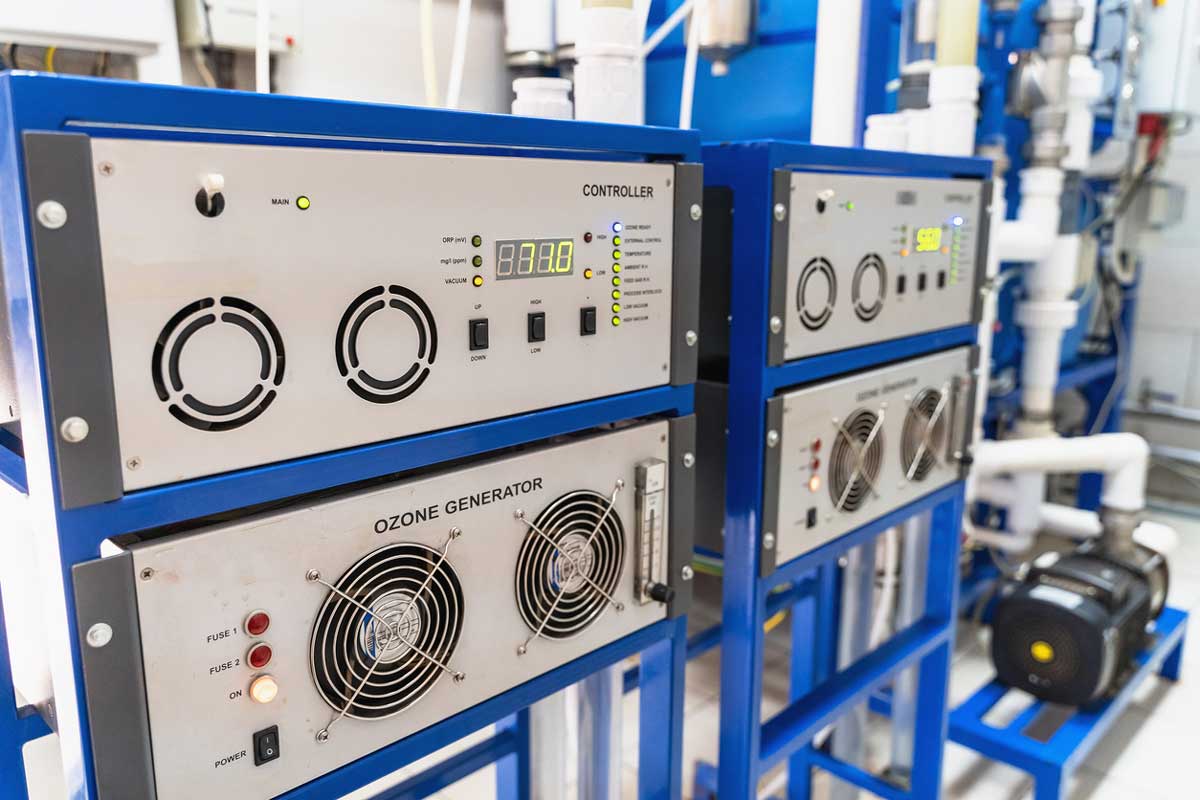
Typical ozone generator includes:
- Feed gas preparation (dryers, oxygen concentrators).
- Generator cell.
- Power supply (high-voltage transformer/inverter).
- Cooling system.
- Ozone destructor (catalytic or thermal for off-gas).
- Monitoring (ozone concentration, flow).
Safety: Venting, ambient monitors.
Applications
- Water Treatment Municipal drinking water, wastewater, bottled water, swimming pools. Disinfects (Cryptosporidium-resistant), removes color/odor, degrades micropollutants.
- Air Purification Odor control (food processing, waste facilities), mold remediation, HVAC sterilization.
- Food and Beverage Surface sanitation, shelf-life extension (fruits, seafood), CIP systems.
- Medical and Pharmaceutical Sterilization (equipment, water), wound therapy (ozonated oils), dental water lines.
- Industrial Pulp bleaching (chlorine-free), semiconductor cleaning, textile processing.
- Aquaculture Water disinfection without residues.
Advantages and Limitations
Advantages:
- Broad-spectrum disinfection (bacteria, viruses, protozoa).
- No persistent byproducts (unlike chlorine → trihalomethanes).
- On-site generation eliminates transport/storage risks.
- Effective against biofilms.
Limitations:
- High energy consumption (10-20 kWh/kg ozone).
- No residual disinfection (requires secondary stabilizers).
- Corrosion potential (materials compatibility critical).
- Toxicity risks (ventilation required).
Safety and Regulatory Aspects
- Occupational limits: OSHA 0.1 ppm TWA; NIOSH 0.1 ppm ceiling.
- Off-gas destruction mandatory.
- Water treatment: CT values for pathogen credits (EPA, WHO).
Market Trends
- Oxygen-fed systems for higher yield.
- Medium-frequency generators for efficiency.
- Modular, containerized units for mobility.
- Integration with AOPs (advanced oxidation processes: ozone+UV/H₂O₂).
- Sustainability: Energy recovery, low-carbon electricity.
Conclusion
Ozone generation provides a powerful, residue-free oxidation and disinfection tool across water, air, food, and industrial sectors. Corona discharge remains the workhorse technology, continually refined for efficiency and reliability. As regulations tighten on chemical disinfectants and demand grows for sustainable processes, ozone’s role expands, supported by modular systems and integration with complementary technologies. Safe design and operation ensure its continued value as an environmentally compatible oxidant.
More articles by ZMR Researche:
https://www.zionmarketresearch.com/de/report/refurbished-running-shoes-market
https://www.zionmarketresearch.com/de/report/one-wheel-electric-scooter-market
https://www.zionmarketresearch.com/de/report/industrial-adhesives-market
https://www.zionmarketresearch.com/de/report/sulphur-bentonite-market