The Proton Exchange Membrane Fuel Cell (PEMFC), also known as Polymer Electrolyte Membrane Fuel Cell, is a type of low-temperature fuel cell that converts hydrogen and oxygen into electricity, producing water and heat as byproducts. PEMFCs are characterized by a solid polymer membrane (typically Nafion or similar perfluorosulfonic acid materials) that conducts protons while acting as an electronic insulator and gas separator.
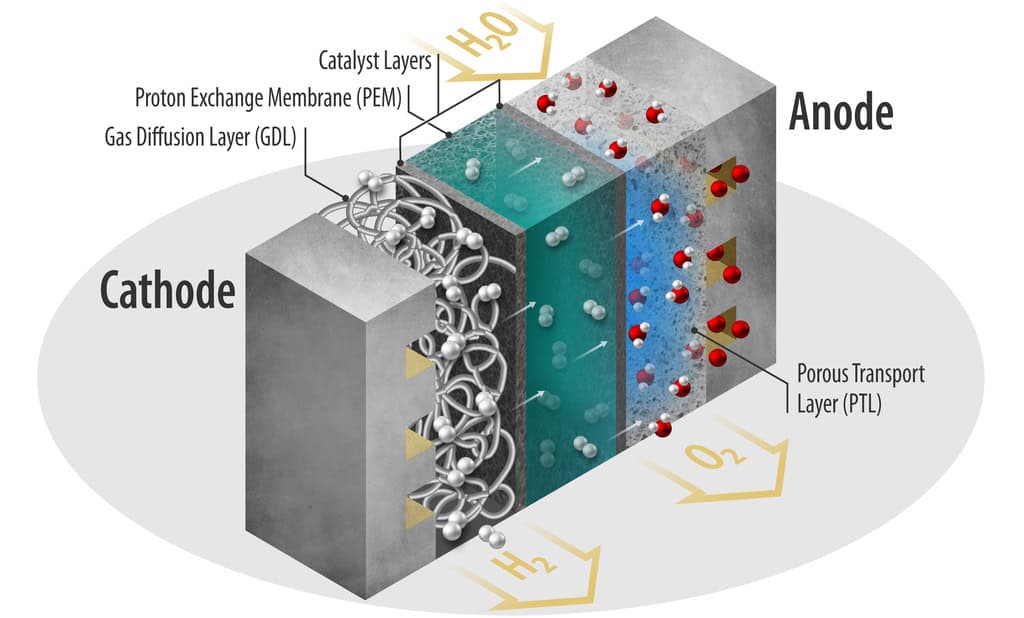
Developed in the 1960s by General Electric for NASA’s Gemini space program, PEMFCs gained renewed interest in the 1980s-1990s with advances in membrane technology and catalysis. As of 2025, Proton Exchange Membrane Fuel Cells dominate applications requiring rapid startup, compact design, and high power density, including automotive fuel cell electric vehicles (FCEVs), stationary power generation, portable devices, and unmanned systems. Global installed capacity exceeds 1 GW, with automotive deployments leading (Toyota Mirai, Hyundai Nexo, Honda CR-V e:FCEV). The PEMFC market is valued at USD 5-7 billion, projected to reach USD 30-50 billion by 2030 under hydrogen economy growth scenarios.
PEMFCs offer zero-emission operation (water only), high efficiency (40-60% electrical), quiet performance, and fuel flexibility (pure hydrogen or reformate), positioning them as a cornerstone of decarbonized energy and transport.
Operating Principle
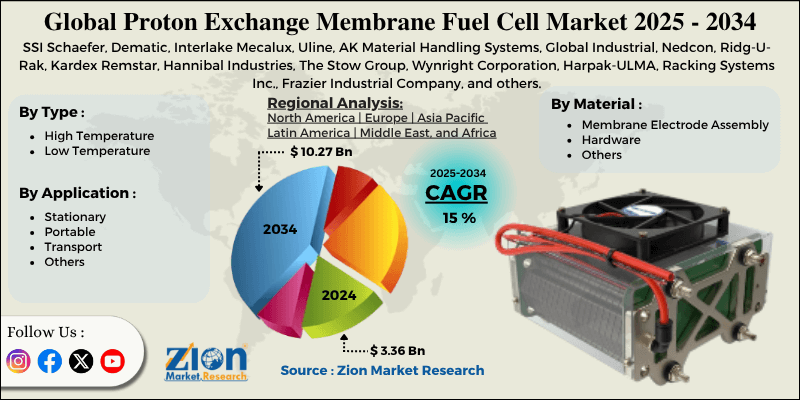
PEMFC operation follows electrochemical principles:
- Anode Reaction: Hydrogen (H₂) oxidizes at catalyst: H₂ → 2H⁺ + 2e⁻
- Proton Conduction: H⁺ ions migrate through hydrated polymer membrane.
- Cathode Reaction: Oxygen (O₂) reduces: ½O₂ + 2H⁺ + 2e⁻ → H₂O
- Overall: H₂ + ½O₂ → H₂O + electricity + heat
Electrons flow externally, generating DC power. Theoretical voltage: 1.23 V/cell; practical stack ~0.6-0.7 V/cell at load.
Key requirements:
- Humidification (membrane hydration).
- Platinum catalyst (anode/cathode).
- Bipolar plates for gas distribution/current collection.
Components and Materials
A PEMFC stack comprises repeating units:
- Membrane Electrode Assembly (MEA)
- Proton Exchange Membrane: PFSA (Nafion dominant); thickness 10-50 μm.
- Catalyst Layers: Pt or Pt-alloy nanoparticles on carbon support (0.1-0.4 mg/cm² loading).
- Gas Diffusion Layers (GDL): Carbon paper/felt with microporous layer.
- Bipolar Plates Graphite, stamped stainless steel, or titanium; flow fields for reactant distribution.
- Gaskets/Seals: Prevent gas crossover.
- End Plates and Stack Assembly: Compression for contact.
Advances:
- Low-Pt/Pt-free catalysts (Fe-N-C).
- Reinforced membranes (durability).
- 3D-printed flow fields.
Performance Characteristics
- Power Density: 1-2 W/cm² (automotive targets >2 W/cm²).
- Efficiency: 50-60% LHV electrical; >85% with heat recovery (CHP).
- Operating Temperature: 60-80°C (low-temperature).
- Startup Time: Seconds (cold start challenges below freezing).
- Lifetime: Automotive 5,000-8,000 hours; stationary >40,000 hours.
Applications
- Transportation
- FCEVs: Toyota Mirai (>700 km range), Hyundai Nexo.
- Buses, trucks (Nikola, Hyundai Xcient).
- Trains (Alstom Coradia iLint), ships (auxiliary).
- Stationary Power
- Backup/UPS (data centers).
- Combined heat/power (micro-CHP: Panasonic Ene-Farm).
- Portable
- Drones, military power packs.
- Emerging
- Aviation (H2 aircraft concepts).
- Material handling (forklifts).
Advantages
- High power density.
- Rapid startup/load response.
- Zero tailpipe emissions.
- Quiet operation.
- Modular/scalable.
Challenges and Limitations
- Cost: Platinum (~USD 30-40/g), membranes.
- Durability: Catalyst degradation, membrane thinning.
- Hydrogen Infrastructure: Storage, distribution.
- Water Management: Flooding/drying.
- Cold Start: Freezing issues.
- Fuel Purity: CO intolerance (<10 ppm).
Mitigation: PGM-free catalysts, advanced membranes, system integration.
Market and Commercial Status
- Automotive: ~50,000 FCEVs globally; California, Japan, Korea lead.
- Stationary: >500 MW installed (Japan dominant).
- Manufacturers: Ballard, Plug Power, Toyota (stack), Hyundai.
Trends:
- Heavy-duty transport focus.
- Green hydrogen integration.
- Cost reduction (DOE targets <USD 30/kW by 2030).
Environmental Impact
- Zero operational emissions (water only).
- Lifecycle: Hydrogen production key (green H₂ ideal).
- Platinum mining concerns; recycling programs.
Future Developments
- High-temperature PEM (120-180°C) for simplified cooling.
- Anion Exchange Membrane (AEM) alternatives.
- Direct methanol/ethanol PEM variants.
- AI-optimized stack design.
Conclusion
Proton Exchange Membrane Fuel Cells offer clean, efficient energy conversion with rapid response and scalability, positioning them as a leading hydrogen technology for transport and power. Decades of refinement have overcome early limitations, with current focus on cost, durability, and infrastructure. As green hydrogen production scales and policy supports (EU Hydrogen Strategy, U.S. H2Hubs), PEMFCs will play a pivotal role in decarbonizing hard-to-electrify sectors, complementing batteries in the sustainable energy landscape. Continued materials innovation and manufacturing scale will drive broader adoption.
More articles by ZMR Researche:
https://www.zionmarketresearch.com/de/report/pour-point-depressants-market
https://www.zionmarketresearch.com/de/report/liquid-crystal-polymers-lcps-market
https://www.zionmarketresearch.com/de/report/hyaluronidase-market
https://www.zionmarketresearch.com/de/report/anticoagulant-reversal-drugs-market