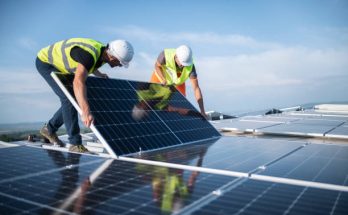
Solar Farms: Harnessing the Sun’s Power on a Grand Scale in 2025
Introduction
Solar farms, also known as solar parks or photovoltaic (PV) power stations, represent the industrial backbone of the global renewable energy revolution. These expansive arrays of ground-mounted solar panels transform vast tracts of land into clean energy powerhouses, generating electricity at utility scale to feed national grids and power millions of homes. Unlike residential rooftop systems, solar farms prioritize efficiency through economies of scale, leveraging advanced PV technology to capture sunlight and convert it into direct current (DC) electricity, which is then inverted to alternating current (AC) for distribution.
As of December 2025, solar farms have become a cornerstone of the energy transition, driven by plummeting panel costs, supportive policies like the U.S. Inflation Reduction Act (IRA), and urgent climate imperatives. The global solar farm market, valued at approximately USD 140-183 billion in 2025, is exploding with double-digit growth, projected to reach USD 298-793 billion by 2033 at CAGRs ranging from 12.51% to 20.1%. This surge reflects not just technological maturation but also a paradigm shift: solar is now the cheapest new-build electricity source in most regions, outpacing fossil fuels and enabling energy security amid geopolitical tensions. This in-depth article explores the anatomy of solar farms, their mechanics, benefits and challenges, market dynamics, leading projects and players, installation economics, and visionary trends shaping their future through 2030.
What Is a Solar Farm?
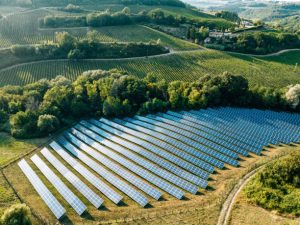
A solar farm is a large-scale installation of solar panels designed for commercial electricity generation, typically spanning 100 acres or more and producing 1-2,000 megawatts (MW) or greater. These facilities differ from smaller distributed solar (e.g., rooftops) by their centralized, grid-tied nature, where power is sold wholesale to utilities rather than consumed on-site.
Key classifications include:
- Utility-Scale Solar Farms: The dominant type, exceeding 1 MW, often 100+ MW, powering entire cities or regions.
- Community Solar Farms: Smaller (1-5 MW) arrays allowing subscribers (e.g., renters or low-income households) to buy shares of output, promoting equitable access.
- Agrivoltaic Farms: Dual-use systems combining solar with agriculture, such as sheep grazing under panels or shade-tolerant crops.
Solar farms thrive in sunny, flat terrains like deserts or former farmlands, with panels mounted on fixed or single-axis trackers to optimize sun exposure. By 2025, they account for over 80% of new global solar capacity additions, underscoring their role in decarbonization.
How Do Solar Farms Work?
Solar farms operate on photovoltaic principles, scaled for mass production. Sunlight strikes PV panels, exciting electrons in silicon cells to generate DC electricity. This flows through strings of panels to inverters for AC conversion, then to transformers for grid-compatible voltage (e.g., 33 kV). Here’s the workflow:
- Energy Capture: Panels (monocrystalline, polycrystalline, or thin-film) absorb photons; bifacial designs capture reflected light from the ground, boosting output 10-25%.
- Conversion and Conditioning: Central or string inverters handle DC-to-AC, with maximum power point tracking (MPPT) optimizing yield. Surge protectors and monitoring systems ensure safety.
- Transmission: Power travels via medium-voltage cables to a substation, where step-up transformers connect to the high-voltage grid.
- Storage and Management (Optional): Battery energy storage systems (BESS) like lithium-ion or flow batteries store excess for peak demand or nighttime use, addressing intermittency.
- Monitoring: IoT sensors and AI software track performance, predicting maintenance and enabling virtual power plant (VPP) integration.
A 100 MW farm might produce 150-200 GWh annually in optimal conditions (e.g., Southwest U.S.), enough for 15,000-20,000 homes, with capacity factors of 20-30%.
Benefits of Solar Farms
Solar farms deliver multifaceted value, aligning economic, environmental, and social imperatives.
- Environmental Gains: Zero-emission operation cuts CO2 by 0.4-0.6 tons/MWh; a 100 MW farm avoids 60,000-80,000 tons annually. Agrivoltaics boosts biodiversity, with pollinator habitats under panels increasing yields 10-20%.
- Economic Advantages: Job creation (300,000 U.S. solar jobs in 2025); land leases ($900-1,400/acre/year) provide farmers stable income exceeding crop profits. ROI of 8-15% with 7-12 year payback.
- Energy Security: Reduces fossil fuel imports; BESS integration enables 24/7 dispatchable power, stabilizing grids amid extreme weather.
- Scalability and Resilience: Modular design suits diverse terrains; floating variants on reservoirs conserve water and land.
In 2025, solar farms power 5-10% of U.S. electricity, with community models democratizing access for 10 million subscribers.
Drawbacks and Challenges
Despite promise, solar farms face hurdles:
- Land Use Conflicts: Require 5-7 acres/MW, sparking NIMBY opposition and farmland loss; agrivoltaics mitigates but adds 10-20% cost.
- Intermittency and Storage: Daytime-only generation demands BESS ($200-300/kWh), raising upfront costs 20-30%.
- Upfront Capital: $0.85-1.23/W installed; supply chain vulnerabilities (e.g., polysilicon tariffs) inflate prices.
- End-of-Life Management: 25-30 year lifespan creates recycling challenges; only 10% of panels recycled globally in 2025.
- Grid Integration: Transmission upgrades needed for remote sites, delaying projects 1-2 years.
Policy solutions like streamlined permitting and recycling mandates are addressing these.
Installation Process and Cost Analysis
Building a solar farm involves:
- Site Assessment: Solar irradiance mapping, geotech surveys (3-6 months).
- Permitting/Financing: Environmental impact studies, PPAs (6-12 months).
- Procurement/Construction: Panel delivery, racking install, wiring (3-6 months).
- Commissioning: Grid interconnection, testing (1-2 months).
2025 costs: $0.85-1.23/W for utility-scale, or $850K-1.23M/MW. A 1-acre farm (0.15-0.2 MW) runs $127K-246K, excluding land ($1K-5K/acre lease/year). O&M: $18K-32K/MW annually.
ROI: 8-15%; payback 7-12 years post-30% ITC. A 5 MW farm yields $300K-500K/year revenue at $0.05-0.08/kWh PPA rates.
Future Trends to 2030
By 2030, solar farms will evolve dramatically:
- Efficiency Leaps: Perovskite-tandem cells hit 30%+ efficiency; bifacial/tracking standard (60% adoption).
- Hybrids & Floatovoltaics: Solar + wind/BESS/hydro; floating farms on reservoirs grow 14% CAGR, covering 10% of global water bodies.
- AI/IoT Integration: Predictive maintenance cuts downtime 20%; VPPs enable P2P trading via blockchain.
- Agrivoltaics Boom: Dual-use on 50% of new farms, blending energy with food production.
- Space-Based Solar: Beaming to Earth farms for 24/7 power (pilots by 2030).
- Policy Push: EU Fit for 55, U.S. IRA extensions drive 50% of new electricity from solar.
Global capacity could hit 4-5 TW, with recycling mandates ensuring circularity.
Conclusion
Solar farms in 2025 embody humanity’s scalable bet on renewables: vast, efficient, and increasingly indispensable. From China’s megaprojects to U.S. community arrays, they slash emissions, create jobs, and deliver robust ROI amid falling costs. Challenges like land and intermittency persist, but innovations in agrivoltaics, storage, and AI herald a resilient future. As we target net-zero by 2050, solar farms aren’t just energy sources—they’re engines of equity and prosperity. For developers, landowners, or investors, the sun’s potential has never been brighter; seize it to power tomorrow’s world.
More articles by InnovateIQ Researche:
https://www.zionmarketresearch.com/de/report/chambered-doctor-blade-systems-market
https://www.zionmarketresearch.com/de/report/femoral-canal-brush-market
https://www.zionmarketresearch.com/de/report/idi-contact-technology-market
https://www.zionmarketresearch.com/de/report/oil-mist-separator-market
https://www.zionmarketresearch.com/de/report/cross-traffic-alert-market